geeky NEWS: Navigating the New Age of Cutting-Edge Technology in AI, Robotics, Space, and the latest tech Gadgets
As a passionate tech blogger and vlogger, I specialize in four exciting areas: AI, robotics, space, and the latest gadgets. Drawing on my extensive experience working at tech giants like Google and Qualcomm, I bring a unique perspective to my coverage. My portfolio combines critical analysis and infectious enthusiasm to keep tech enthusiasts informed and excited about the future of technology innovation.
Backstage at GTC Berlin: NVIDIA Jensen Huang on China, Debt, Demand and Durable GPUs
AI Summary
At GTC Berlin, Jensen Huang defended the economics of GPU-backed debt, arguing that Nvidia’s programmable chips stay productive for 7 to 8 years, far longer than skeptics claim. To help neoclouds turn idle capital into revenue faster, Nvidia unveiled its DSX POD container design to speed up data center deployment, though power constraints remain a bottleneck. Huang also addressed Nvidia’s financial backstops for customers, recommended a hybrid approach for enterprise AI models, and touched on global talent trends, noting China’s rapid rise in top AI researchers.
November 07 2026 03:48
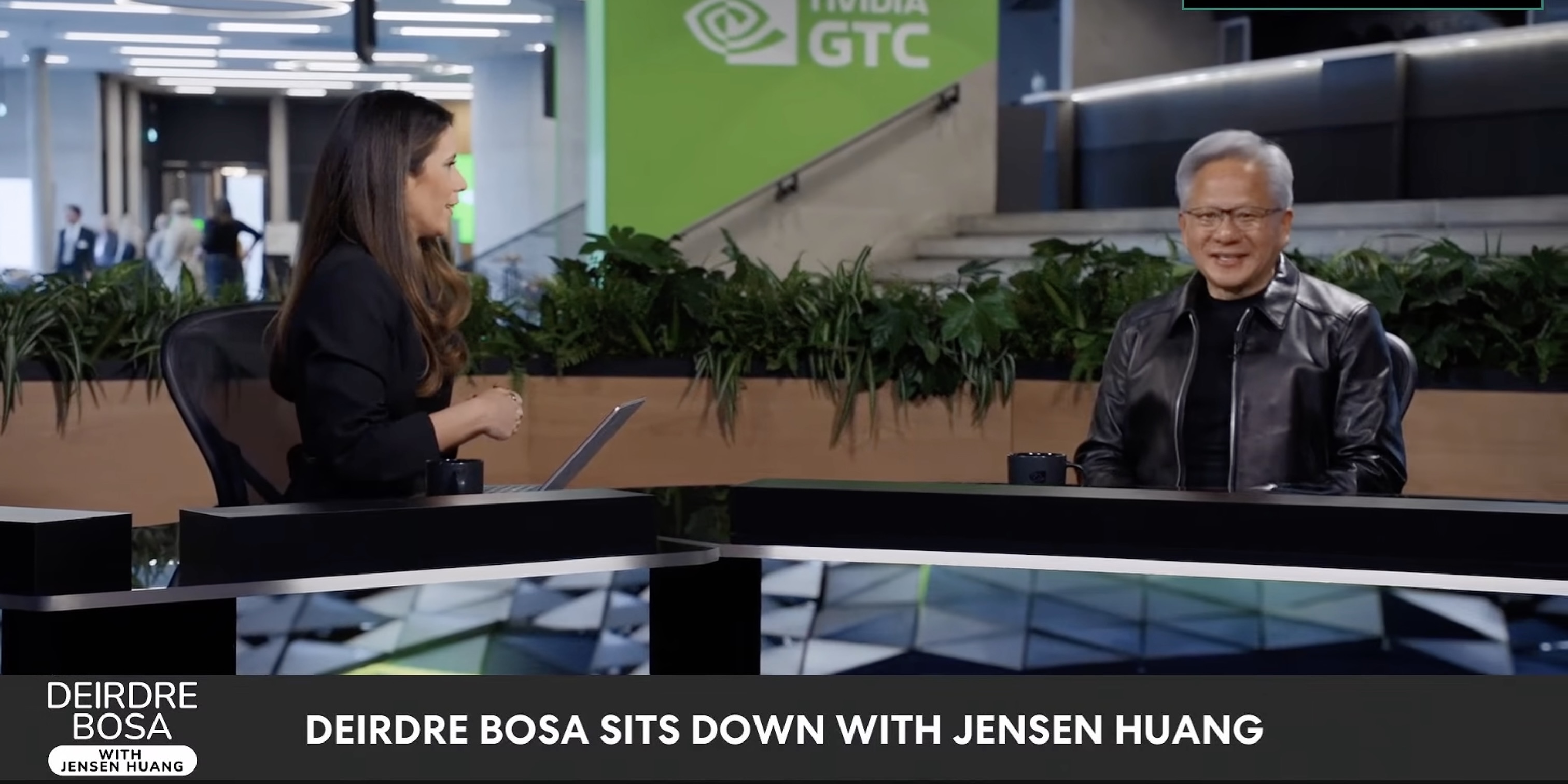
Jensen Huang walked off the stage at GTC Berlin in October and straight into a live interview with business journalist Deirdre Bosa. She skipped the product talk and went to the question that has been rattling the AI trade for weeks: can the neoclouds, the newer companies that rent out GPUs, actually pay for all of this?
Huang's answer was that the chips themselves are the answer. It is a clever argument, and it is also one that benefits the person making it. Both things can be true, so it is worth walking through.
The core argument: GPUs as collateral
Huang says Nvidia GPUs stay productive far longer than people assume. The old rule of thumb was a four year life. He now puts it at eight years or more, and when Bosa asked whether seven to eight years is a fair estimate for Blackwell, he said "probably." He expects the same for the next generation, Vera Rubin.
His reasoning is that Nvidia's chips are programmable, so software updates keep improving them long after they ship. They are also fungible, meaning there is always another company that can use the compute. If a chip is productive, easy to resell and durable, he says, a lender can write a loan against it. Today, he argued, "nobody gives a credit for that" residual value, and he thinks that will change.
Why does this matter? Because lenders have been uneasy about GPU backed debt. Investor Michael Burry argued late last year that the real economic life of an AI chip is only two to three years, see the Hashrate Index on neocloud economics and the Burry depreciation argument. If he is right, the collateral could lose its value before the loan is repaid. If Huang is right, the same loans look much safer.
What the evidence says about GPU lifespans
The accounting side of this debate is messy. The big three cloud providers settled on six year depreciation schedules, while neoclouds are more cautious, with Lambda at five years and Nebius at four SiliconANGLE analysis of GPU depreciation schedules. One independent analysis argues these numbers are not contradictory at all: chips can last seven to nine years physically, sit on the books for six, and pay back their cost in two to four.
The market data this year leans toward Huang. Nvidia's CFO said H100 rental prices rose 20 percent in 2026 so far, and older A100 rentals rose 15 percent. Rising prices for old chips are the opposite of what a short lifespan would predict. Gavin Baker, who joined the interview, pointed to Blackwell prices climbing for 17 days in a row, and one report confirmed that Blackwell Ultra rentals hit a record high in mid October.
There is a caveat. Strong prices today say a lot about a market where demand outruns supply. They say less about what happens in a slowdown, which is exactly when a lender needs the collateral to hold up.
The idle cash problem and the shipping container
Huang's second answer was about time. A gigawatt of data center costs roughly $50 billion, he told Bosa. From the moment Nvidia ships the components until the site is running can take four to six months, and the buyer has already paid for all of it. That is a lot of money sitting idle.
Nvidia's new DSX POD is meant to shrink that gap. It is a reference design for a shipping container that partners fill with seven Vera Rubin racks plus networking and cooling, tested at the factory before it leaves. Nvidia says it can cut deployment at a prepared site from six months to as little as 14 days, with partner built systems arriving in early 2027. In the interview, Huang was more modest and talked about taking three to four months out of the process.
Huang's own framing is the useful one. An AI factory, he said in the launch announcement, creates value when it starts producing tokens, not when construction finishes. Shorter waits mean less idle cash and an earlier start on revenue, which is what lenders care about.
The container does not fix everything. An analyst note on the launch pointed out that it does nothing for access to grid power, which remains the main constraint in Europe. Huang admitted as much. Bottlenecks keep moving, he said, from wafers to memory to photonics to connectors, and now to power, land and construction. The launch was also met with a Greenpeace protest in Berlin, a reminder that community pushback is part of the picture too.
Nvidia has skin in this game
The detail that changes how you read Huang's argument is that Nvidia is not a neutral observer. It already stands behind some of the financing. Under its backstop program, Nvidia agrees to rent back a neocloud's unused GPUs at a fixed rate, and it takes a share of revenue above that floor. Firmus and Sharon AI were among the first to sign on.
So when Huang says the risk of underwriting Nvidia hardware is the lowest of any asset out there, he is making a claim he has already put some of his own money behind. That does not make him wrong. It does mean lenders should check the numbers rather than take the pitch.
Compute starts to trade like a commodity
Bosa also pressed him on how computing power is beginning to trade like oil or wheat. CME launched regulated GPU rental futures on October 5, tied to H100 and B200 rental indexes. Bosa noted that Nebius has moved to spot pricing that can change every 15 minutes.
Volatility is the reason this exists. Spot prices for Blackwell rentals rose 48 percent in about two months this spring, from $2.75 to $4.08 per GPU hour. Huang's view is that this works in his favor, because a chip that many customers can use and easily resell is the kind of asset a market can price. A skeptic would say that a market with swings like that also shows how uncertain the future value really is.
Rent the frontier, build your own only when you must
On open models, Huang gave practical advice that most businesses can use. He said roughly $600 billion of venture money went into AI startups in the first half of this year, and about 80 percent of those startups use open models. Take a strong open model, train it further on your own data, and you get something that performs well in your specific field.
His rule of thumb: rent a closed frontier model whenever you can, and build your own AI only when you must. Companies like Dassault, Cadence and Siemens, he said, have to build their own because their expertise is the product. Baker added that many of his portfolio companies run a custom open model behind a router that also calls a closed frontier model. Huang's summary was that the future of AI will be hybrid, much as cloud computing is today.
The jobs argument
Huang was blunt about AI and jobs. He said the narrative that AI destroys work is "precisely wrong," arguing that AI has created more software, healthcare and legal jobs, and that energy, chips, construction and manufacturing are all hiring across the supply chain.
The data is more mixed than either side admits. Stanford's 2026 AI Index found employment for software developers aged 22 to 25 down nearly 20 percent since late 2022. At the same time, software engineering openings are up about 30 percent this year, even as tech layoffs continued. New York Fed researchers found it hard to pin the entry level slowdown on AI alone.
My read is that Huang is right about the total number of jobs and weaker on who gets them. The first rung of the ladder looks shakier than the rest, and a young developer is unlikely to find comfort in a statement about the overall economy. His point about being a good neighbor was more convincing. He said AI builders rushed in too quickly at first, and that data center companies should talk with local communities before they build and leave something useful behind.
Why nobody builds AI researchers like China
Asked about China, Huang said the country should always be taken seriously, because nobody manufactures things at scale like it does, including chips, open models and, in his words, AI researchers. The numbers back him up. A Carnegie China study found that 41 percent of the top AI researchers it tracked worked in China in 2025, compared with 34 percent in the United States. Three years earlier, the United States led 46 percent to 27 percent.
Huang still sees an American edge in frontier labs, chips and infrastructure, and he said the US government wants Nvidia to compete everywhere, including Africa, Central Asia, Brazil and Egypt. He also made a case that safety and capability are the same project, pointing to OpenShell, Nvidia's zero trust approach for AI agents, which gives an agent only the access it needs.