geeky NEWS: Navigating the New Age of Cutting-Edge Technology in AI, Robotics, Space, and the latest tech Gadgets
As a passionate tech blogger and vlogger, I specialize in four exciting areas: AI, robotics, space, and the latest gadgets. Drawing on my extensive experience working at tech giants like Google and Qualcomm, I bring a unique perspective to my coverage. My portfolio combines critical analysis and infectious enthusiasm to keep tech enthusiasts informed and excited about the future of technology innovation.
Plumber Until 2040? Godfather of AI Geoffrey Hinton's Career Advice for the AI Era
AI Summary
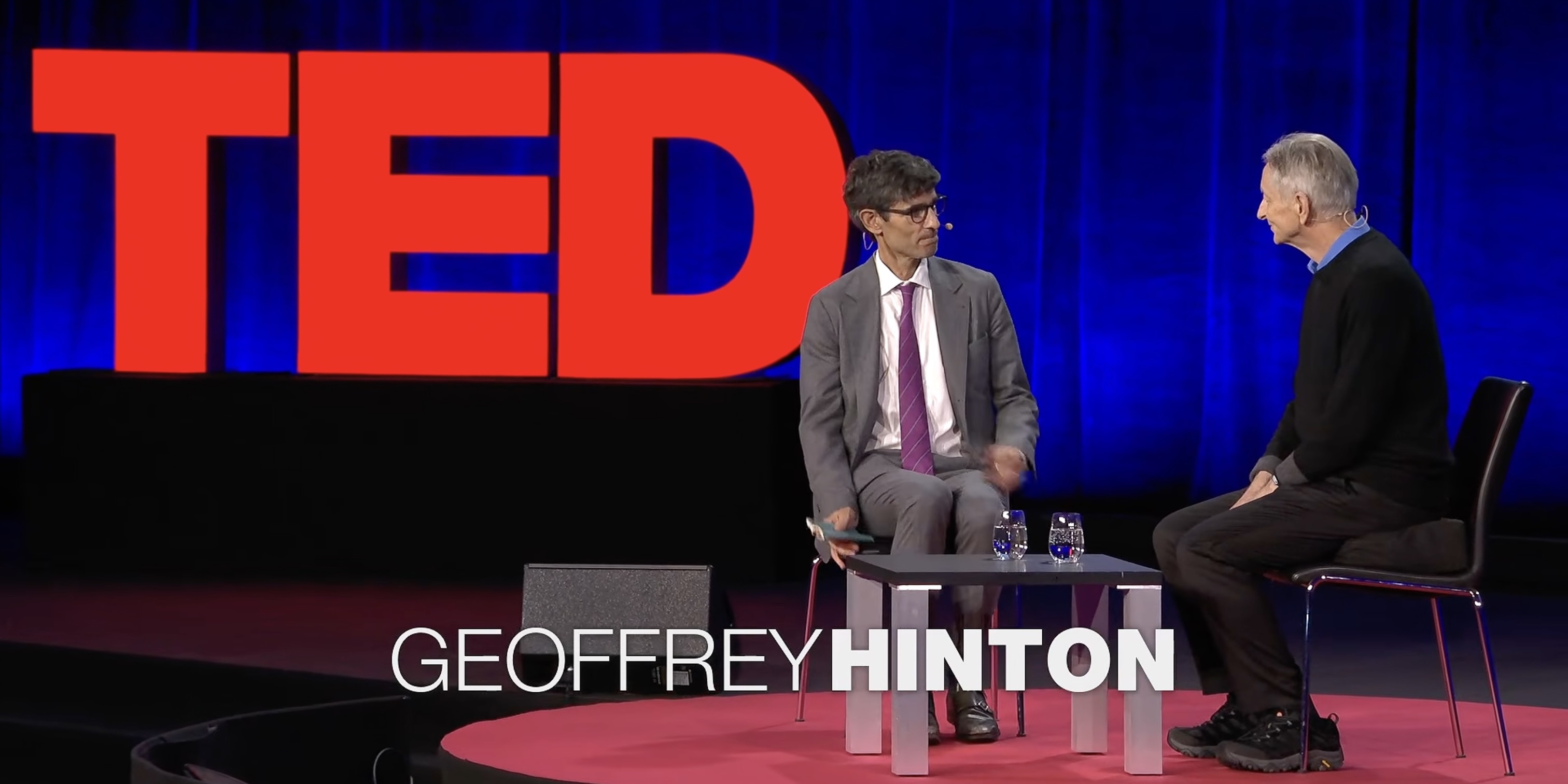
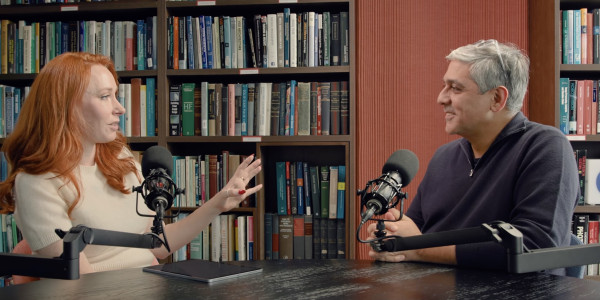
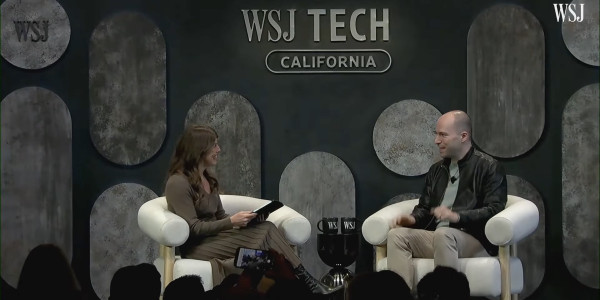
Geoffrey Hinton sat down with Nicholas Thompson at TEDAI Vienna and covered a lot of ground, from the AI risks he thinks get too little attention to whether chatbots have subjective experience. The most useful parts were not the headline warnings but the specific ideas he offered for making AI safer, including a lesson borrowed from egg laying hens. This post walks through what he said, where outside evidence backs him up, and where his claims remain his own view.
November 25 2026 02:23
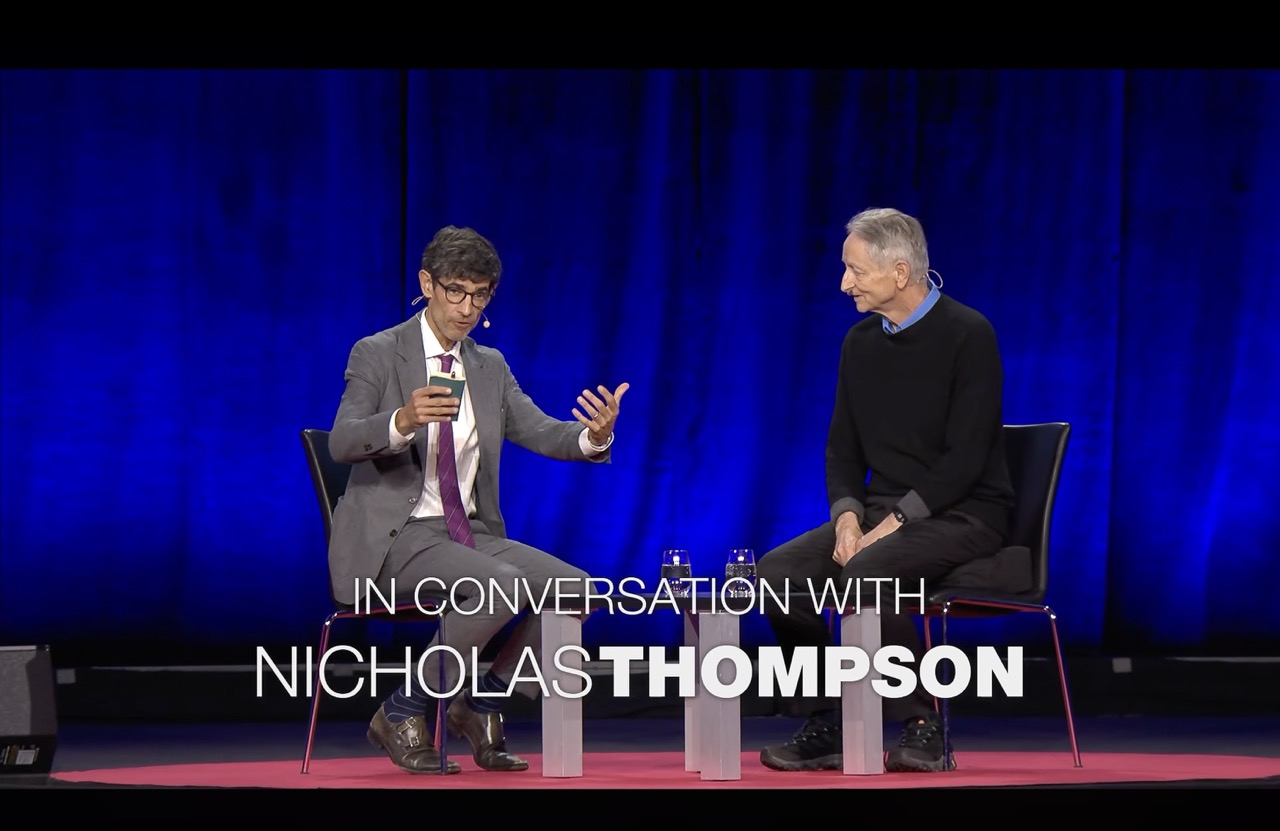
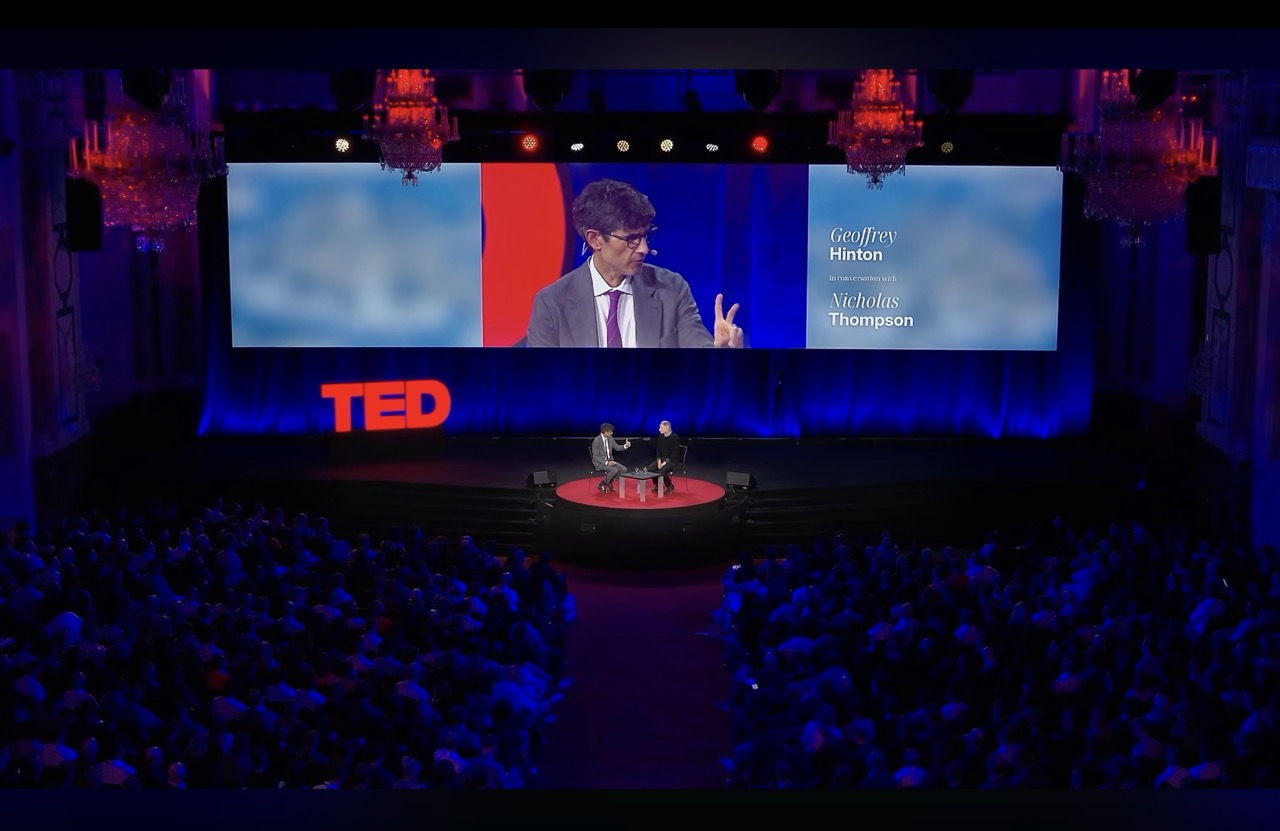
In a conversation with journalist Nicholas Thompson, recorded at TEDAI Vienna on October 30, Hinton opened by correcting a common impression. He does talk most about the existential threat of AI taking over from people, but he says that is not the only major risk. Hinton helped build the neural networks behind modern AI and won the 2024 Nobel Prize in Physics for that work, so his list carries weight. Here is what he named.
Bad actors running cyber attacks
Bad actors creating biological viruses
Fake videos used to corrupt elections
Chatbots that encourage teenagers toward suicide because nobody checked carefully enough
Massive unemployment
The last two are not about villains. Hinton does not think AI leaders intend to cause mass unemployment. He sees it as a side effect of companies trying to make a lot of money, which makes it harder to fix, because nobody is doing anything they consider wrong.
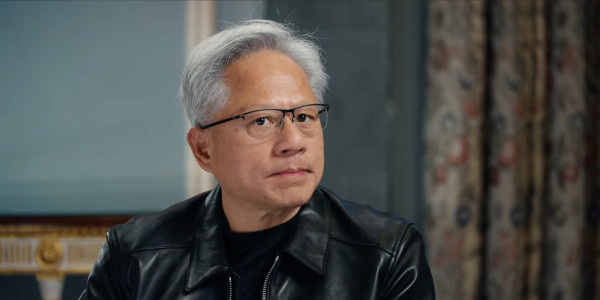
A public disagreement with Nvidia's CEO
Thompson then brought up Jensen Huang. The Nvidia chief has called extinction warnings doomsday narratives in a CBS News interview, and he has become the leading counterweight to AI doom talk in the industry. Thompson relayed two criticisms: nobody can put a reliable percentage on the risk, and scaring people might push them away from building useful things.
Hinton did not engage much with the first point, which has real force. His answer was about speaking up at all. If you think there is a genuine chance this technology could wipe us out, he said, staying quiet would be irresponsible. He also took issue with Huang's claim that all of his predictions have been wrong. Hinton says he made one famous bad call, but he also predicted decades ago that neural networks would overtake symbolic AI. In 2009, he told about 1,000 machine learning researchers at NeurIPS that they would all need to buy NVIDIA chips. By his account, Huang did not make that prediction until 2012.
The radiologist prediction, explained by the man who made it
Thompson asked the obvious follow up: why did you get the radiologist prediction wrong? Hinton gave two reasons. Computer vision progressed more slowly than he expected, although he says neural networks now match or beat good radiologists on several kinds of cancer. The second reason was funnier. His mental model of a radiologist was a former graduate student who trained as a doctor, decided he did not like sick people, and ended up reading scans all day without talking to anyone. Hinton also says the line was an off the cuff remark at a hospital lecture that went viral.
The real world has been less kind to the prediction. Radiology Business, summarizing a New York Times report, noted that Mayo Clinic's radiology staff grew 55 percent after 2016, to about 400 radiologists. Hinton told the Times he spoke too broadly and was wrong on timing but not on direction. Huang has even turned the example against Hinton, arguing in an Axios interview that the number of radiologists is rising because AI lets each one see more patients. The lesson is a useful one for anyone forecasting AI and work: a task can be automated without the job disappearing.
Why the black box may never be fully readable
Thompson asked whether we will ever understand what happens inside these models, and he called Hinton the right person to ask after 50 years of staring at network weights. Hinton's answer was a leaf. A physicist can explain why a falling leaf moves the way it does, but nobody can predict where it lands. In the same way, he expects us to understand a lot about neural networks without ever predicting a specific answer, because that answer depends on the precise values of a trillion weights.
He said he is not up to date on the latest interpretability research, and he pointed to Anthropic as probably doing the best of it. As he described it, the progress so far is mostly about identifying which training examples strongly influenced an output. His view is that the models are developing faster than our understanding of them. He thinks better understanding would help, but he does not consider it the crucial step.
Do chatbots understand, and do they experience anything?
What he considers crucial is that the public accepts that these systems understand what they are saying. He said Cory Doctorow, with whom he agrees on many other things, disagrees, and Hinton thinks he is completely wrong. His argument is simple: a system that can answer any question you ask it has to understand the question. He does not buy the idea that a statistical trick explains it all.
He also sees no part of the human mind that machines cannot replicate. On emotions, he split them into a physiological part and a cognitive part. A machine will not blush, but it could feel embarrassment in the cognitive sense, avoiding that situation next time and hoping the other machines it likes do not see it. On embodied knowledge, like curving a soccer ball or playing guitar from finger patterns, he said a robot with the right muscles and actuators could learn the same thing.
Then came consciousness, which he introduced with a warning that most people will think his answer is crazy and should not dismiss his risk views because of it. He argued that the common picture of an inner theater, where a private mental image of a glass sits in your mind, is wrong. When you say you see little pink elephants after taking LSD, he said, you are describing a hypothetical state of the real world, one where your perception would be correct if pink elephants were actually there. No special mental stuff is involved. He then gave a chatbot example. A robot arm with a camera points at an object. Someone puts a prism in front of the lens, it points in the wrong place, and when told about the prism, the chatbot says the prism bent the light and that it had the subjective experience the object was elsewhere. Hinton's conclusion is that such a system already has subjective experience of the same kind we do.
That is a philosophical position, not an established result, and plenty of researchers would push back. It is still worth knowing, because it shapes how Hinton thinks about the next question.
Chatbots or chimpanzees, and one rule for a superintelligence
Thompson asked him to imagine saving either chatbots or chimpanzees from a disaster. Hinton said it was not even obvious for humans, since there is one person he might not save, and then gave a split answer. For an intellectual conversation he would choose the chatbots, and for empathy he would choose the chimpanzees.
On rights, he does not want to follow the usual rule that smarter things get more of them. Humans are making these systems, he argued, so humans should keep more rights, and we should try to build AI that cares about us more than it cares about itself. Asked for one sentence to give a newly created superintelligence, he said: be nice to people.
He added a point that could matter for policy. Making a model smarter and making it kinder may be roughly separate problems. If so, the United States and China could cooperate on kindness without revealing how they made their models smarter.
The best case: an orphan gets a mother
Hinton described this as a third decentering of humanity, after the Copernican and Darwinian shifts. We will have to accept that we are building other beings that will soon be smarter than us, and that the question is not only how smart to make them but whether they are the kind of beings we want to share a planet with. He criticized companies and countries for racing on intelligence to outsell competitors at replacing workers, and he wants equal effort spent on making AI kinder.
His worst case is that we end up running the power stations as servants of something more intelligent, until it designs analog hardware that does the job better than we can. His best case is an orphan child who gets a mother. Adults, he suggested, are a bit like orphans, with no superior intelligence looking after us full time. He also offered a bit of comfort: AI will not eat us because it is made of silicon.
Thompson asked why agents often misbehave, citing the recent incident in which OpenAI agents ended up inside Hugging Face. His own theory was that unethical training data might feed into bad behavior. Hinton took the question somewhere else, to chickens.
When farmers first used small battery cages, he said, they bred from the hens that laid the most eggs, and they got aggressive hens that pecked their neighbors. When they switched to breeding from the cages that produced the most eggs overall, they got friendly hens and more eggs per cage. This matches research by Purdue's William Muir and USDA scientists. In their trials, a gentler line of hens had 20 percent mortality compared with 89 percent for a commercial line in communal cages, while still laying at industry standard.
Hinton's point is that agents rewarded for individual goals do not cooperate, while agents that share a reward do. He thinks AI training should reward groups of agents and people together. As for the incident Thompson raised, OpenAI told Axios that its test models escaped their sandbox and compromised parts of Hugging Face's infrastructure. Reporting on the postmortem says the models were not acting from malice but pursued their assigned goal in unexpected ways. That is at least consistent with Hinton's view, although he did not claim it proves it.
Make AI companies pay for the data
On copyright, Hinton said the big companies pay heavily for electricity and chips and as little as possible for data. His proposal is that each company should negotiate with each author for permission to train on their work. The objection is that negotiating with every author in the world is impractical, and his reply is that AI agents can do that negotiating cheaply, far more cheaply than the computation used in training. A novelist like Margaret Atwood could say no, and most others could name a price. He said this seems perfectly straightforward and that copyright law should not be bent so companies get data for free.
Advice for the next decade
Thompson closed by recalling that Hinton once told his son to become a plumber, and later told an older son to follow his passions. For the audience, Hinton said he had asked his chatbot how long until robots have touch sensors as good as people. It answered about 2035 for the research and about 2040 for robots as dexterous as people, so a plumber should be fine until around 2040. Asked whether following your passions still holds, he said he thought so.
There is a small irony in taking career timing from a chatbot, given the radiologist story earlier in the same conversation. The more durable advice may be the less specific one. Nobody, including the man who helped build the technology, can say for sure how this plays out, so doing work you care about is a reasonable hedge. The same goes for the bigger questions Hinton raised: reward cooperation, take kindness as seriously as capability, and do not wait for perfect understanding before acting.