geeky NEWS: Navigating the New Age of Cutting-Edge Technology in AI, Robotics, Space, and the latest tech Gadgets
As a passionate tech blogger and vlogger, I specialize in four exciting areas: AI, robotics, space, and the latest gadgets. Drawing on my extensive experience working at tech giants like Google and Qualcomm, I bring a unique perspective to my coverage. My portfolio combines critical analysis and infectious enthusiasm to keep tech enthusiasts informed and excited about the future of technology innovation.
Jensen Huang's Blueprint for Winning the AI Race Against China
AI Summary
Jensen Huang argues that America’s AI competition with China is far more complex than headlines suggest, focusing on a “five layer stack” – energy, chips, infrastructure, AI models, and applications. While the U.S. maintains an edge in chip technology and AI models, China dominates energy capacity, manufacturing, and open-source development, creating significant competitive disadvantages. Huang stresses that America’s ambivalence towards energy growth and its reluctance to reindustrialize are key vulnerabilities.
December 21 2025 19:22
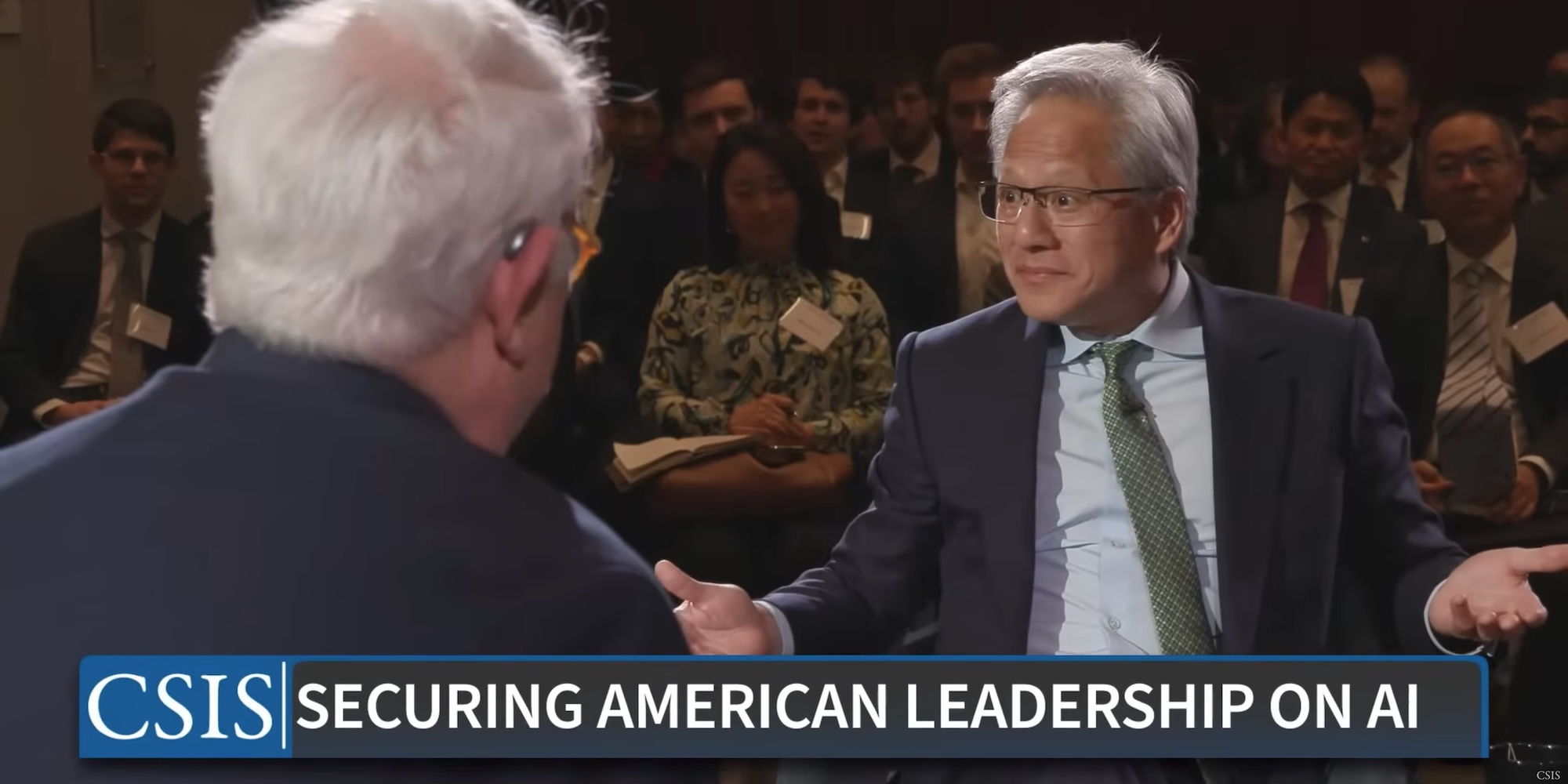
Speaking recently in Washington, the Nvidia CEO laid out a sobering assessment: China has twice the energy capacity of the United States, can build hospitals in a weekend while American data centers take three years, and leads the world in open source AI models. Yet Huang remains adamant that America can win this race, if policymakers understand what they're actually competing for.
The conversation revealed something more nuanced than the typical "us versus them" narrative dominating headlines. Huang described AI not as a single technology but as a five layer system, and America's competitive position varies dramatically across each layer. Understanding this framework is essential for anyone trying to make sense of where the AI revolution is heading and what's at stake for American technological leadership.
The Five Layer Stack: Why AI Competition Is More Complex Than It Seems
Huang breaks down AI into five distinct layers, each with its own competitive dynamics. At the foundation sits energy. Here, China holds a commanding advantage with double America's electricity generation capacity. This isn't an abstract concern. Every chip factory, supercomputer plant, and AI data center requires massive amounts of power. When you're trying to reindustrialize a nation that spent decades offshoring manufacturing, energy becomes the bottleneck for everything else.
The second layer is chips, where Nvidia and American semiconductor companies maintain a generational lead. But Huang cautions against complacency. Semiconductors are ultimately a manufacturing business, and China excels at manufacturing. Chinese chip companies receive energy discounts of 50 percent, free employee transportation, and other subsidies that make American production costs four to eight times higher. It's a stark reminder that technological superiority alone doesn't guarantee market dominance.
Infrastructure forms the third layer, encompassing the software, cloud systems, and physical facilities needed to deploy AI at scale. The contrast is striking: breaking ground on an American data center and getting it operational takes roughly three years. China, according to Huang, can build a hospital in a weekend. That velocity matters enormously when first movers gain ecosystem advantages that compound over time.
The fourth layer contains AI models themselves. American frontier models from OpenAI, Anthropic, Google, and others lead by perhaps six months. But this narrow view misses a crucial point. Of the 1.5 million AI models in the world, most are open source, and China dominates open source development. Without open source, startups can't thrive, researchers can't experiment, and industries can't adapt AI to their specific needs. China's lead here resembles what happened with 5G, where Huawei's early infrastructure deployment created lasting advantages.
At the top sit applications, where AI actually creates value in healthcare, manufacturing, transportation, and countless other industries. Huang points to a revealing cultural difference: 80 percent of Chinese citizens believe AI will do more good than harm, while Americans tend toward the opposite view. Whoever applies technology first and most broadly wins industrial revolutions. Britain invented electricity, but America's faster adoption powered its economic dominance for the next century.
The Huawei Problem: Competing With Both Hands Tied
Nvidia faces a peculiar challenge. The company has been banned from selling advanced chips to China by the United States government. China has also banned Nvidia from its market. Huang jokes that his company is probably the first in history to be banned on both sides, but the implications are serious.
America has effectively conceded the world's second largest technology market. Huang draws a parallel: you can't replace America as an export market, and you can't replace China either. The country is singular in the global economy. Walking away from an entire market of that scale hands competitors an enormous home field advantage where they can achieve scale, refine products, and build ecosystems without any American competition.
Meanwhile, Huawei has emerged as one of the most formidable technology companies in the world. The notion that restricting American chip exports would set back China's AI industry hasn't materialized. Instead, China's semiconductor industry has been doubling annually, while the rest of the world grows at 20 to 30 percent. When an opponent starts on second base and you're still approaching the batter's box, the head start matters.
The Belt and Road Initiative demonstrated China's strategy for technology proliferation. Just as they did with 5G infrastructure, Chinese companies are working to diffuse AI technology globally as quickly as possible. Getting there first creates sticky relationships. Ecosystems build on top of whatever platform arrives earliest, and switching costs become prohibitive. Nvidia enjoyed a 25 year head start building its ecosystem, giving it time to connect industries and applications before competitors arrived. China aims to replicate that advantage in emerging markets.
The Ecosystem Advantage: Why China's AI Infrastructure Runs Deeper Than Headlines Suggest
Nine of the world's top 10 science and technology schools are now in China, a complete reversal from a decade ago. Half of the world's AI researchers are Chinese. China published 70 percent of AI patents last year. This represents a deep bench of talent that extends far beyond a handful of flagship companies.
The ecosystem of AI software developers in China is vibrant and innovative. These aren't just people working on ChatGPT equivalents. They're building AI that understands genes, proteins, chemicals, and the laws of physics. They're developing AI for quantum computing, robotics, financial pattern recognition, and healthcare diagnostics. The 1.4 million AI models being developed globally span every field of science and every industry. Focusing only on large language models misses the breadth of what's actually happening.
With American companies largely absent from the Chinese market, all that talent and infrastructure is now building a complete domestic stack from chips through applications. Once completed, that stack will be exported as quickly as possible to countries throughout the developing world. The risk, according to Huang, is that America becomes a buyer rather than a seller in global AI markets.
Industrial Policy: When Heavy Handed Intervention Makes Sense
Huang admits he's uncomfortable in Washington. He's a technologist, not a policy expert. But he recognizes that the Trump administration inherited a situation requiring dramatic intervention, and he credits several policy shifts as essential for American competitiveness.
First, reversing the vilification of energy growth. You cannot build new industries without electricity. The service economy runs on calories, but manufacturing requires massive amounts of power. Huang argues that decades of treating energy expansion as inherently problematic did the country a profound disservice. No matter how advanced American AI technology becomes, it cannot be deployed at scale without addressing the energy constraint.
Second, reindustrializing America. The largest segment of the economy outside of knowledge work is manufacturing, and America offshored most of it over the past two decades. Creating prosperity for people without PhDs or college degrees requires bringing manufacturing back. The AI industrial revolution provides a unique opportunity to do so, and Huang has committed to building half a trillion dollars in AI supercomputers during the current presidential term.
This isn't just about Nvidia. It's about the ecosystem of suppliers, the Taiwan Semiconductor Manufacturing Company facilities in Arizona, South Korean memory manufacturing, and Taiwanese companies like Foxconn helping establish systems manufacturing in America. Huang notes that the quality of Taiwanese beef noodle soup in Arizona has improved dramatically, a lighthearted reference to the thousands of Taiwanese families who relocated to help stand up American chip factories. When he spoke at a TSMC graduation ceremony in Arizona, two thirds of the audience was Taiwanese.
Third, maintaining technology leadership. American technological dominance and national security are inseparable. The fact that the world relies on American technology to build their industries, ecosystems, and economies is a strategic advantage. It keeps America safe when everyone works with American platforms and standards. Nvidia was born in the United States, operates at the center of the most important industrial revolution in human history, and exports American technology wherever the government permits.
The Robot Revolution: Why Physical AI Arrives Sooner Than You Think
Last year, the world installed two million robots. Half went to China. Huang describes why robotics represents the next major AI breakthrough and why it's closer than most people realize.
Consider video generation AI. You can type a text description and the AI generates a video, pixel by pixel. You can give it a screenshot as a starting condition and say "cause Jensen to reach over and pick up the cup," and the AI manipulates pixels to show that action. The AI doesn't distinguish between manipulating pixels and manipulating motors. Taking that AI from the cloud and embodying it in physical mechanical systems is clearly possible.
China has major advantages here. They have enormous demand because manufacturing is core to their economy and they face severe labor shortages. They have leading AI technology. And critically, they excel at mechatronics, the intersection of electronics and mechanical engineering. The harmony of demand side need and supply side capability positions them well.
Japan has demand and mechatronics expertise but needs better AI technology. Germany has demand and excellent mechatronics but also needs to improve AI capabilities. America has great software and AI technology, and will have significant demand if reindustrialization succeeds, but currently lags in mechatronics. Using AI to find better vegan recipes is cute, but turning AI into productive machinery is what will actually transform economies.
The Jobs Question: Task Automation Versus Job Elimination
Seven or eight years ago, a prominent AI scientist declared that radiology would be the first profession eliminated by AI. Computer vision had achieved breakthroughs, and within five years, he predicted radiologists would lose their jobs. He advised students not to enter the field.
Every single radiology platform has now been transformed by AI. And the number of radiologists has increased.
The distinction, Huang explains, is between tasks and jobs. Studying scans is a task radiologists perform. The job of a radiologist is diagnosing disease. AI dramatically enhances the task, making radiologists more productive. But it doesn't eliminate the job because diagnosis requires human judgment, patient interaction, and integration of multiple information sources.
The pattern repeats across professions. People predicted software engineers would disappear because AI can now code. Nvidia gave AI assistants to all its engineers, and they're busier than ever. A financial analyst's task is manipulating spreadsheets, but the job is providing financial advice, helping customers, and making market predictions. The human element remains significant.
Huang's writing has improved with AI. Not the quality or voice or taste, which remain his, but the speed. When adapting concepts from previous speeches into new contexts, AI helps generate first drafts. Original thought, original writing, and human taste retain value. Before deciding AI is something to fear, he suggests, actually engage it. Use it. Understand what it does and doesn't do.
The Energy Bottleneck: Why Nvidia's Next GPU Weighs Two Tons
People sometimes mention GPUs being smuggled, which Huang finds amusing. A gaming graphics card is a small module you plug into a PC. An AI GPU is a different beast entirely. It weighs two tons. It contains 1.5 million parts. It consumes 200,000 watts. It costs three million dollars. You'd need enough to fill a football field to run an AI data center.
Nvidia introduces new generations annually, improving performance at the same power consumption by five to ten times each year. Energy efficiency increases dramatically. But demand grows faster. AI is becoming more computationally intensive, and adoption is accelerating. Nvidia is improving efficiency by 10x yearly while demand increases by 10,000x or a million times. All those exponentials create a chase that never ends.
The fundamental constraint remains energy. When Huang says we need to use every form of energy available, build behind the meter, pursue power generation systems, and accelerate nuclear, he's describing an existential challenge. Without solving energy, American AI leadership becomes impossible regardless of how advanced the chips or software become.
Half of the American power grid is merchant suppliers who don't buy ahead of need. When LED lighting reduced electricity demand, the market lost its signal for new capacity investment. Now AI creates explosive demand growth, but the infrastructure to support it doesn't exist. China built out twice the electrical capacity. America is flat. That gap compounds every year.
Why the Best Days Are Still Ahead
Huang doesn't have to work. He's built one of the most valuable companies in human history. His hair has gone from black to gray during this journey. But he won't miss the next decade or two. Not for anything.
The coming twenty years will advance science, industry, and national prosperity more than potentially all previous decades combined. AI will impact every industry, every company, and every country. This is the most consequential industrial revolution in human history, comparable to electricity in its significance.
That optimism comes from someone who has seen the technology's trajectory up close. Nvidia contributed more to American economic growth last year than perhaps any other single company. It's a multi hundred billion dollar company supporting multi hundred billion dollar companies pursuing trillion dollar industries. The economic prosperity, technology leadership, and national security benefits are real and measurable.
The quintessential American story, Huang calls it. His parents had the American dream. His father wanted the family to grow up in the United States and sent him here at age nine with almost nothing. Through that journey, he ended up leading one of the most consequential companies in human history. You can't write a better story. You can't not be romantic about this country.
Working with every nation in the world gives Huang perspective. American capabilities are extraordinary. The ecosystem of scientists, engineers, and technology partners represents something close to a miracle. Complacency would be foolish, but the foundation is stronger than the anxious headlines suggest.
Washington remains foreign to him. He's clumsy at policy discussions. But he has an open door to explain what AI actually is, how it will evolve, and why certain policies might achieve short term objectives while creating dire long term consequences. Technology leadership and national security are inseparable. Securing one requires the other.
Huang's message to policymakers is direct. America's technology industry is among the mightiest the world has ever seen. Going toe to toe with any competitor, American companies have nothing to fear. But you cannot concede entire markets and expect to maintain leadership.
Above all, the coming decades represent an opportunity America cannot afford to miss. The country that led the last industrial revolution by adopting electricity faster and more broadly than its competitors must do the same with AI. The science will advance. Industries will transform. National prosperity will grow. But only if policymakers understand what they're competing for and make choices that enable American technology leadership rather than inadvertently undermining it.