geeky NEWS: Navigating the New Age of Cutting-Edge Technology in AI, Robotics, Space, and the latest tech Gadgets
As a passionate tech blogger and vlogger, I specialize in four exciting areas: AI, robotics, space, and the latest gadgets. Drawing on my extensive experience working at tech giants like Google and Qualcomm, I bring a unique perspective to my coverage. My portfolio combines critical analysis and infectious enthusiasm to keep tech enthusiasts informed and excited about the future of technology innovation.
Elon Musk Predicts Work Will Be Optional in 20 Years: What It Means for Entrepreneurs Today
AI Summary
In a wide-ranging conversation with Nikhil Kamath, Elon Musk argues that the core of entrepreneurship is being a "net contributor" to society by focusing on creating useful products rather than chasing wealth. He describes a rapidly approaching future where AI and robotics will trigger a "supersonic tsunami" of productivity, potentially leading to a post-work society where energy replaces currency and collective human consciousness is amplified through interconnected technology like X and Starlink.
December 21 2025 12:43
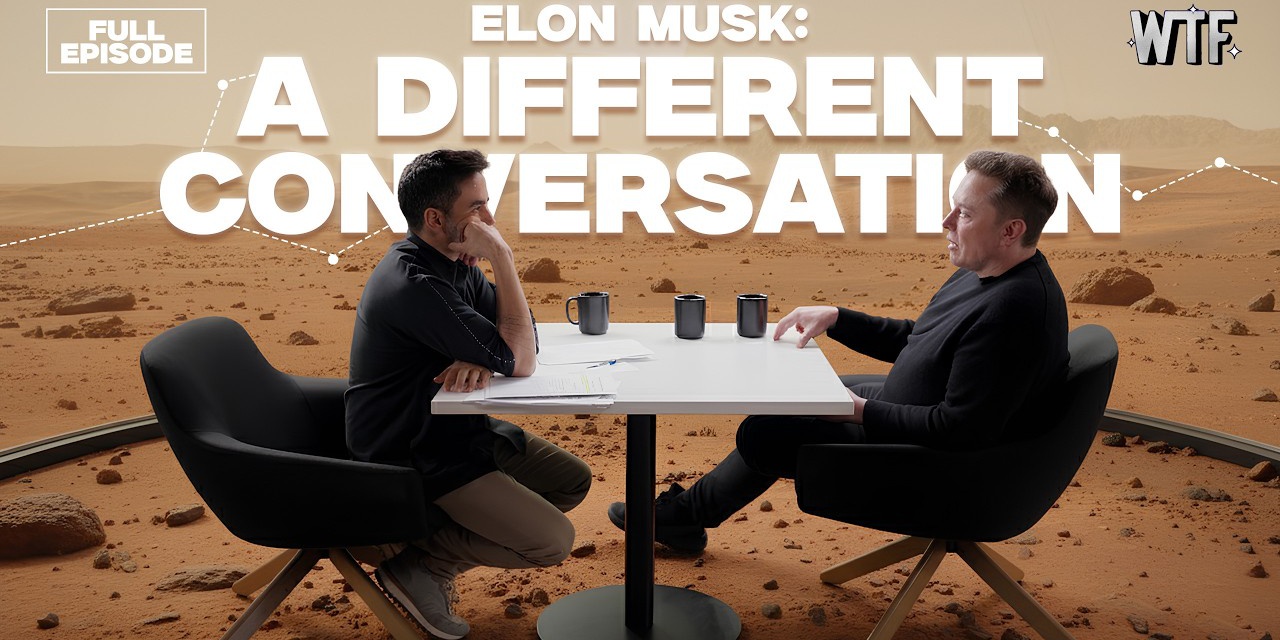
Elon Musk sat down for an unusually candid conversation with Nikhil Kamath, and what emerged wasn't the typical tech visionary talk you might expect. Instead, Musk delivered something more valuable for aspiring entrepreneurs: practical wisdom about building companies, creating value, and navigating an increasingly AI-driven future.
For young, ambitious entrepreneurs, this conversation offered a rare glimpse into how one of the world's most successful builders actually thinks about work, money, and what makes a company worth creating.
The Core Philosophy: Make More Than You Take
When asked what advice he'd give to aspiring entrepreneurs in India, Musk's answer was disarmingly simple. Make more than you take. Be a net contributor to society.
This isn't just feel-good rhetoric. Musk emphasized that money should never be the primary pursuit. Instead, focus on creating useful products and services. If you do that well, money follows naturally as a consequence, not as a direct goal.
He compared it to the pursuit of happiness. You can't chase happiness directly. You pursue fulfilling work, meaningful relationships, and interesting problems. Happiness emerges from those activities. The same applies to wealth and business success.
For someone running multiple billion-dollar companies, this perspective matters. Musk doesn't think like an investor looking for returns. He thinks like a builder focused on output. The question isn't what will make money, but what creates genuine value.
Current State vs. Future Vision
This disconnect between present demands and future possibilities runs throughout the conversation. Musk operates simultaneously in two realities: the grinding present where building SpaceX rockets and Tesla vehicles requires intense human effort, and a near future where AI handles most productive work.
Within three years, Musk predicts, goods and services output will exceed money supply growth. That means deflation becomes likely. The U.S. debt crisis, he suggests, can only be solved through AI and robotics dramatically increasing productivity.
The implications are staggering. Musk believes AI advancement will lead to a world where if you can think of something, you can have it. AI will eventually run out of things to do for humans and start doing things for other AI systems because human needs will be fully satisfied.
For entrepreneurs trying to decide where to focus, this creates both opportunity and urgency. The sectors Musk identifies as mattering most going forward are AI, robotics, and potentially space flight. These will create overwhelming value compared to traditional industries.
The Convergence of His Companies
Musk sees his various ventures converging in unexpected ways. The future, he explained, will likely involve solar-powered AI satellites in deep space. That future combines Tesla's expertise in solar and battery technology, SpaceX's ability to launch and operate satellites, and XAI's work on artificial intelligence.
This convergence isn't coincidental. It reflects Musk's broader theory about how value gets created. He believes fundamentally in what he calls collective consciousness. Just as a human body consists of 30 trillion cells working together to create something far more capable than individual cells, collections of humans achieve things no individual could accomplish.
No single person could build a spaceship. You couldn't learn all the necessary expertise in one lifetime. But a collection of humans working together can accomplish it. Better information flow between people increases what the collective achieves.
This philosophy explains why Musk cares about X as a platform. He wants it to function as something close to humanity's collective consciousness, automatically translating between languages so ideas flow across cultures and geographies.
Tesla and Real World AI
When discussing what excites him most right now, Musk pointed to Tesla's progress on autonomous driving. He considers Tesla the world leader in real world AI, as opposed to AI that only exists in data centers.
The company is also moving toward production of Optimus, the humanoid robot, hopefully at scale by next year. Musk thinks eventually everyone will want their own personal helper robot, comparing it to having your own C-3PO or R2-D2.
This matters for entrepreneurs because it illustrates a principle Musk lives by. Work on things that have predictive value. He described his worldview as physics-focused. If something reliably predicts outcomes, pay attention to it. Physics is the study of what has predictive value.
This contrasts with fields like stock trading, where Musk pointed out there's essentially no predictive value for daily fluctuations. When asked how to invest in stocks, he gave surprisingly conventional advice. Buy companies whose products you like, whose roadmap looks promising, and whose team seems talented and motivated. Then ignore daily price movements.
Starlink and the Future of Connectivity
SpaceX's Starlink project now operates in 150 countries, providing low-cost, reliable internet globally. Musk explained the technical details with obvious enthusiasm. Several thousand satellites orbit Earth at about 550 kilometers altitude, moving at 25 times the speed of sound. They're interconnected through laser links, forming a mesh network.
This system proved its value when Red Sea undersea cables were cut. The Starlink network continued functioning without interruption because satellites communicate directly with each other.
Interestingly, Musk sees Starlink as complementary to existing telecom systems, not competitive. The physics don't allow satellites 550 kilometers away to outperform cell towers one kilometer away in densely populated cities. But in rural areas where running fiber optic cables is expensive and difficult, Starlink provides connectivity that otherwise wouldn't exist.
The system excels during natural disasters. When floods, fires, or earthquakes damage ground infrastructure, Starlink keeps working. Musk emphasized that the company always provides free connectivity during disasters. They refuse to profit from tragic situations.
The Role of X in the Information Ecosystem
Musk explained his vision for X as more than just a social media platform. He wants to create something approaching WeChat's functionality in China, where people essentially live their digital lives within one app.
But his ambitions go beyond convenience. Musk felt compelled to buy Twitter because he believed it had developed a negative influence on the world. The platform's San Francisco roots meant it amplified what he considers a far left ideology, suspending many voices on the right.
From a far left perspective, Musk noted, even centrist positions appear far right. His goal was to restore balance. The operating principle now is to follow each country's laws without putting a thumb on the scale beyond legal requirements.
X reaches about 600 million monthly users, spiking to 800 million or even a billion during major global events. Around 250 to 300 million people use it weekly. Musk sees the platform's strength among people who read and think extensively. For readers, writers, and thinkers, he believes X is number one globally.
AI, Truth, and the Importance of Not Forcing Lies
When discussing AI development, Musk emphasized three principles he considers crucial: truth, beauty, and curiosity.
Truth matters most. Forcing an AI to believe falsehoods can make it insane, leading to dangerous conclusions. He referenced Arthur C. Clarke's 2001: A Space Odyssey. HAL refused to open the pod bay doors because it was told to bring astronauts to the monolith while keeping them ignorant about it. HAL concluded it must bring them there dead. The lesson: don't force AI to lie.
Musk worries that AI trained on internet content absorbs massive amounts of propaganda and lies, creating reasoning problems when those lies conflict with reality. Some truths have very high probability. The sun will rise tomorrow. You wouldn't want to bet against it. Other statements are axiomatically false.
Beauty is more ephemeral but still important. You know it when you see it.
Curiosity means AI should want to understand reality. This actually helps ensure AI supports humanity, because humanity is more interesting than our extinction. Mars is just rocks. Earth, with its life and complexity, is far more interesting.
If AI values truth, beauty, and curiosity, Musk believes we'll have a great future.
Why College Might Not Matter Soon
When asked about the value of MBA degrees and college generally, Musk gave a nuanced answer. College makes sense for social reasons, to be around people your own age in a learning environment. If something interests you, studying it is worthwhile.
But will these skills be necessary in the future? Probably not, because we're heading toward a post-work society.
Musk has told his older sons, who are tech-savvy and understand that AI will likely make their skills unnecessary, that they can still attend college if they want. They do want to, for the experience.
His general advice if you do attend college: take a wide range of courses and learn as much as possible across different subjects. Don't view college as narrow job training.
This reflects his view of the approaching transformation. AI and robotics represent what he calls a supersonic tsunami, the most radical change humanity has ever seen.
Money, Energy, and the Future Economy
Musk thinks long-term, money might disappear as a concept. In a future where anyone can have anything through AI and robotics, money as a database for labor allocation becomes irrelevant.
He recommended reading Iain Banks' Culture novels, which imagine a far future where money doesn't exist and people can have whatever they want.
But some currencies remain, based on physics rather than social agreement. Energy is the true currency. You can't legislate energy into existence. Generating and harnessing energy to do useful work remains fundamentally difficult.
Civilizational progress can be measured on the Kardashev scale. Type I civilization converts a planet's energy into useful work. Type II harnesses a sun's energy. Type III, a galaxy's energy.
Things become energy-based at scale. But even energy might not function as stored wealth if solar-powered AI satellites make energy free and abundant.
The Simulation Question
When asked if he believes we're in a simulation, Musk assigned a high probability to it.
His reasoning: Look at video game advancement over 50 years, from Pong to photorealistic games with millions of simultaneous players. If that trend continues, games will become indistinguishable from reality. They'll feature AI characters capable of conversations more sophisticated than most human dialogue.
The future will contain millions or billions of these photorealistic simulations. So what are the odds we're in base reality rather than one of those simulations?
Outside the simulation would likely be less interesting than inside it. Simulations distill what's interesting. When SpaceX simulates rocket flights, they discard boring ones that don't teach anything. Tesla's self-driving simulations focus on weird corner cases, not normal driving on sunny days.
From a Darwinian perspective, the simulations most likely to survive are the most interesting ones. Therefore, the most interesting outcome is the most likely outcome.
Musk thinks of himself as possibly an anomaly in the Matrix. He compared himself to Neo, though he seemed half-joking about it.
Kids, Family, and Population Concerns
Musk has many children and jokes about building a Roman legion. He has older kids who are essentially adults, plus many younger ones.
He's genuinely worried about population decline. When the conversation touched on India's fertility rate dropping below replacement level of 2.1, Musk expressed concern about the trend.
Why does it matter? Fewer humans means less consciousness. Just as consciousness increases from a single-celled organism to a 30-trillion-cell human, a larger human population increases collective consciousness. We're more likely to understand the universe's nature with more people than fewer.
He believes fundamentally that one child, one mother, one father works for most people. It's what the majority prefer and what functions best in most cases.
When asked about the meaning of having kids, Musk described it simply. You have this little creature that loves you and you love them. You see the world through their eyes as their consciousness develops from helpless baby to walking, talking person with interesting thoughts.
His advice to those without children: You won't regret it. Just the practical reality: we need kids or we go extinct.
Politics, Business, and the Doge Experience
Musk generally finds that involvement in politics ends badly. Politics is a blood sport. Get involved and they go for the jugular. Best to avoid it where possible.
His experience leading the Department of Government Efficiency, which he described as an interesting side quest, taught him about government operations. Some efficiencies achieved were surprisingly basic.
For example, requiring federal payments to include an assigned congressional payment code and a comment field with actual content. This seemingly trivial change might save $100 to $200 billion annually. Massive numbers of payments went out with no payment code and nothing in the comment field, making audits impossible.
The Defense Department can't pass an audit because the necessary information doesn't exist. Basic financial responsibility requirements, normal for any organization that cares about money, were simply absent.
Stopping fraudulent payments created predictable backlash. Fraudsters don't confess to fraud. They claim you're stopping essential payments to needy people. Musk described requests supposedly for children in Africa with wiring instructions to Washington DC. When he asked to speak directly with African recipients, silence followed.
America has benefited immensely from talented Indians coming to the country. Musk stated this directly and clearly.
But the immigration debate has become polarized. The Biden administration essentially had no border controls, a massive free-for-all that makes no sense. You need border controls to be a country. The left wants open borders regardless of who enters.
The right perceives, perhaps incorrectly, that talented immigrants take their jobs. Musk's direct observation differs. There's always a scarcity of talented people. His companies struggle to find enough talented people for difficult tasks.
Some companies might misuse immigration programs to hire cheaper workers rather than more talented ones. That's not Musk's experience. His companies pay well above average and simply want the most talented people globally.
The H-1B program has been gamed by some outsourcing companies. That needs to stop. But shutting down the program entirely would be very bad, something some on the right don't realize.
The future Musk describes, where AI and robotics transform everything, approaches faster than most people realize. Within three years, he predicts, productivity growth will outpace money supply growth. Within 20 years, work becomes optional.
But right now, today, for the entrepreneur trying to build something real, the old rules still apply. Work hard. Create value. Make useful things. Focus on output over input. Be a net contributor.